
Read feedback from our customers directly on Google.
View all Google reviews
 5,0
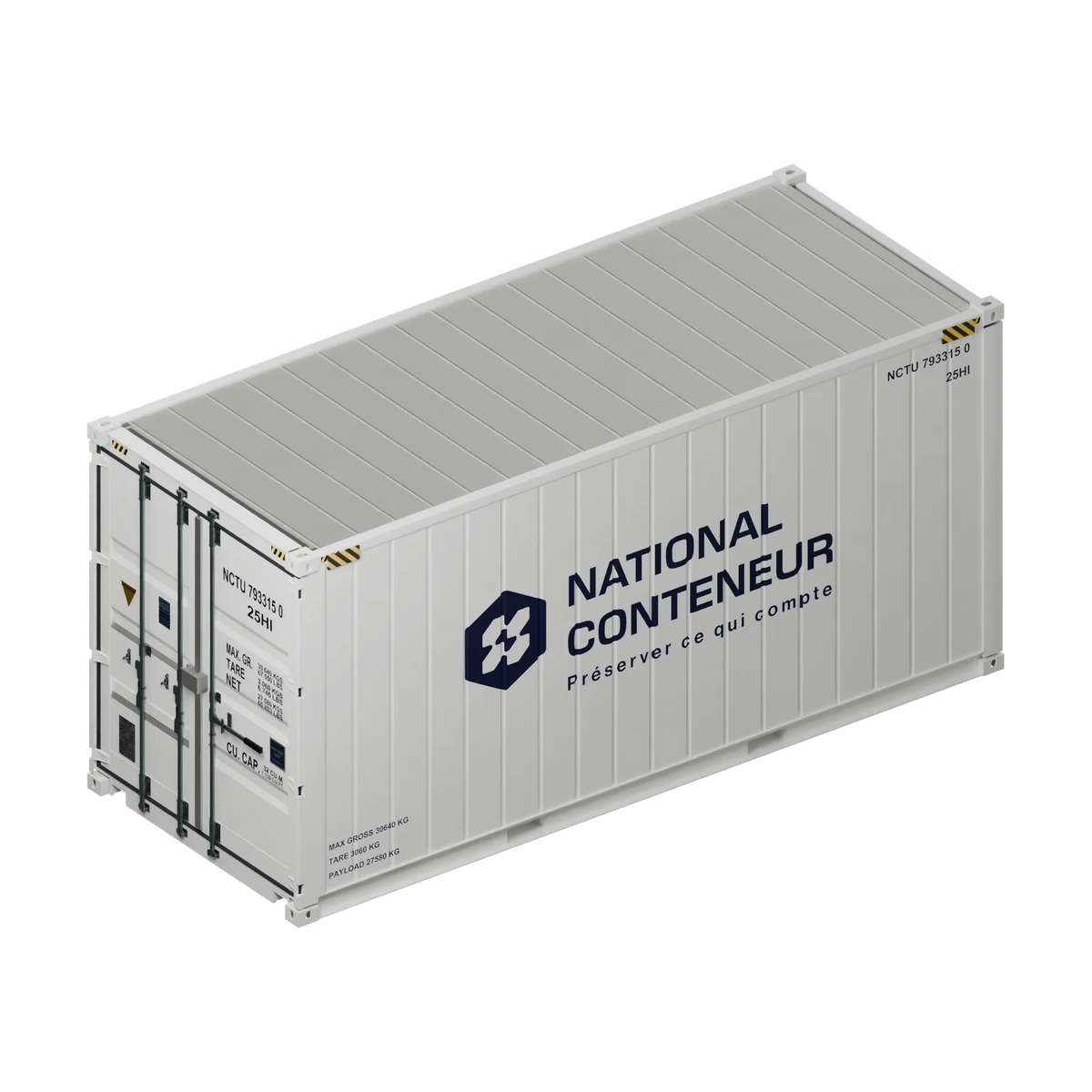
20ft High Cube Insulated Shipping Container — First-Trip
Price on request
First-trip version, this 20 ft Insulated HC container offers 32 m3 with reinforced insulation and extra height, in pristine, certified new condition. A top-quality solution for temperature-sensitive goods requiring large volume.
- Dimensions (LxWxH)
- 6.1 m × 2.4 m × 2.9 m
- Floor area
- 12,5 m²
- Volume
- 32 m³
Your price alert has been created. We will contact you by email when new arrivals match the selected products.
What our customers say
Custom-built
Standard and custom-built modules, individually or assembled.
Expertise
Industry experts to support you with your project.
Express delivery
Reliable and secure transport — a logistics team dedicated to your project.
Competitive pricing
Depots across France, close to you.
Compliance
ISO 9001 and CSC standards.
Devis gratuit
Demander un devis pour ce conteneur
Réponse d'un interlocuteur dédié sous 24 h ouvrées, au prix du marché.
Impossible d'envoyer la demande pour le moment. Veuillez reessayer.
Demande envoyée !
Votre demande a bien été reçue et sera traitée sous 24 h ouvrées. Pour une réponse immédiate, appelez-nous au +33 9 78 45 18 90.
A project involving a container?
Answer 5 questions — we'll guide you to the ideal solution.
Similar products

Conteneur Isotherme
20ft Insulated Shipping Container — First-Trip
Price on request
View product →

Conteneur Isotherme
20ft Insulated Shipping Container — Used
From 4 800,00 €
View product →

Conteneur Isotherme
10ft Insulated Shipping Container — First-Trip
Price on request
View product →

Conteneur Isotherme
10ft Insulated Shipping Container — Used
From 5 760,00 €
View product →
Technical specifications
| External dimensions | 6,058 m × 2,438 m × 2,890 m |
|---|---|
| Internal dimensions | 5,380 m × 2,280 m × 2,540 m |
| Door clearance | 2,280 m × 2,520 m |
| Tare weight | 3 060 kg |
| Payload | 27 580 kg |
| Volume | 32 m³ |
| Floor area | 12,5 m² |
| Materials | Fully welded Corten and stainless steel |
| Floor type | Aluminium rail |
| Door opening | 270° |
| Certifications | CSC |
| Type | Conteneur Isotherme |
| Reference (SKU) | conteneur-20-pieds-isotherme-hc-premier-voyage |
FAQ
What is the lifespan of a container?
With minimal maintenance, a Corten steel container has a lifespan of 20 to 30 years. First-trip units offer the best longevity.
Can a container be customized?
Yes: RAL paint, additional doors, windows, insulation and electrification. Contact us for a custom quote.
Do you offer rental?
Yes, we offer short-term and long-term rental solutions. Contact our team for terms and conditions.
What payment methods do you accept?
Bank transfer, credit card and other payment methods confirmed on the quote. PayPal and interest-free payment in 3 installments are not offered.

20ft High Cube Insulated Shipping Container — First-Trip
Price on quote
Definition
What is a insulated container?
La famille isotherme regroupe les conteneurs isolés sans groupe froid actif. Elle sert à conserver une température plus stable sans produire de froid.
Read more
L’isolation en polyuréthane, un isolant rigide à faible conductivité thermique, ralentit les échanges avec l’extérieur. Le conteneur protège donc contre les variations rapides, mais ne remplace pas un Reefer quand une température précise doit être maintenue.
Le choix dépend de la durée, de la température de départ des marchandises et de l’exposition du site. L’Isotherme convient aux usages tempérés, au hors gel et aux transports courts.
-
Froid passif
Froid passif
L’Isotherme conserve la température sans groupe froid. Il limite la dérive thermique sans consommation électrique continue.
-
Isolation renforcée
Isolation renforcée
Le polyuréthane réduit les échanges thermiques. La performance dépend aussi de l’état des portes, joints et parois.
-
Durée limitée
Durée limitée
Le conteneur ne produit pas de froid. Il convient donc aux durées courtes ou aux usages où une dérive contrôlée reste acceptable.
In detail
What is a 20ft first-trip HC insulated container?
An insulated container is a fully insulated body: its walls slow heat exchange between the goods and the outside. It does not produce cold; it preserves it. "HC," for High Cube, refers to a format raised by about 30 cm compared with the standard format. "First-trip" means it is a new unit, out of the factory after a single trip.
Read more
The body, made of Corten steel and stainless steel, is fully welded. Corten steel is a self-weathering steel that naturally resists marine corrosion. Insulation is provided by polyurethane foam panels; an insulating foam molded between two walls. The aluminum T-bar floor offers a flat, draining surface.
The 20ft HC format frees up 32 m³ of usable volume for a 27,580 kg allowable load, about 5 m³ more than a standard 20ft insulated container. Its interior height of 2.54 m allows two-level palletizing and the storage of vertical packaging.
 Dimensions in millimetres · perspective view
Model dimensions
Usable space and access
- Door opening (W × H)
- 2,280 m × 2,520 m
- Interior (L × W × H)
- 5,380 m × 2,280 m × 2,540 m
Use the internal dimensions to plan the load or equipment layout. Allow the clearances needed for movement, handling and maintenance for your intended use.
Mass and load distribution
Check total mass, point loads, load distribution and handling equipment compatibility. Available volume does not determine permissible load: reference masses are listed in the technical specifications.
Reference dimensions from the product sheet, to be confirmed for the proposed container.
Exterior envelope
Exterior dimensions and installation
- Exterior (L × W × H)
- 6,058 m × 2,438 m × 2,890 m
These dimensions describe the container envelope. Door movements, connections and servicing may require additional space around the unit.
The unloading area depends on the vehicle and lifting method. It must be assessed separately from the container’s final position.
Reference dimensions from the product sheet, to be confirmed for the proposed container.
Read the dimensions guide Dimensions in millimetres · perspective view
Le choix de l’état
Premier voyage ou occasion ?
L’aspect attendu, l’usage et le budget orientent le choix. Demandez les photos et les caractéristiques du conteneur proposé avant de vous décider.


Premier voyage : quel état ?
Un conteneur premier voyage est une unité récemment fabriquée qui a effectué un trajet maritime de positionnement. Son aspect est généralement proche du neuf, mais de petites marques de transport ou de manutention restent possibles.
C’est une option à privilégier pour une installation visible, un aménagement soigné ou un projet où l’état initial compte particulièrement. Demandez les photos et les caractéristiques du conteneur proposé.
Occasion : pour quels usages ?
Un conteneur d’occasion a déjà servi au transport maritime. Les bosses, les reprises de peinture, la corrosion et les réparations varient d’une unité à l’autre : l’appellation seule ne décrit pas son état réel.
Pour le stockage, le chantier ou un usage technique, une occasion contrôlée peut répondre au besoin avec un budget initial plus contenu. Distinguez les traces d’usage acceptables des défauts qui affectent la structure, la fermeture des portes ou l’étanchéité.
Que vérifier avant l’achat ?
- Structure : déformations importantes, trous, corrosion perforante, état du châssis et des coins ISO.
- Portes et joints : ouverture, fermeture, fonctionnement des barres de verrouillage et continuité des joints.
- Plancher et étanchéité : zones molles, réparations inadaptées et entrées de lumière anormales, hors ventilation prévue.
Pour un transport maritime international, faites aussi confirmer la validité CSC et l’aptitude de l’unité au transport prévu. La plaque ne remplace pas l’examen du conteneur.
Budget : que faut-il comparer ?
À format comparable, l’occasion est généralement moins chère à l’achat. Vérifiez aussi ce que le devis inclut : le conteneur, le transport et le déchargement sur votre site.
À format identique, les dimensions nominales restent les mêmes ; la tare et la charge utile se vérifient sur les plaques. Pour un frigorifique, un Open Side ou un conteneur équipé, contrôlez aussi les équipements décisifs pour votre usage : groupe froid, portes ou installations.
In detail
Insulated or Reefer: what is the difference?
The insulated container and the Reefer belong to the same refrigerated family, but rely on two opposite principles. The Reefer, a refrigerated container, carries an active cooling unit: it produces its own cold and maintains a chosen temperature, from −25°C to +25°C. It must stay permanently plugged into a 380V three-phase electrical supply.
Read more
The insulated container, on the other hand, produces no cold at all. It simply slows heat exchange through its insulation and the mass of its body. It works without electricity and without a cooling unit to maintain. To extend autonomy, eutectic plates are added; cold accumulators frozen in advance in a cold room. On the 20ft HC, passive autonomy reaches 24 to 48 hours, the typical duration of regional flows and event catering.
Applications
Uses for a 20ft first-trip HC insulated container
The 20ft HC format is aimed at flows where interior height optimizes vertical packaging.
The applications below show in which contexts this format is most relevant. Each use links the on-the-ground need to the container's concrete benefit.
Highlights
Why buy a 20ft first-trip HC insulated container
The new 20ft HC insulated container combines the increased High Cube height with passive insulation and no cooling unit. The strengths below explain what the extra 30 cm bring to loading and what the absence of a refrigeration circuit changes in autonomy and cost.
The strengths below explain what each technical choice brings to the project. They help compare the product with a less specialized alternative or a different condition.
-
Optimized volume
Optimized volume
32 m³ usable, 5 m³ more than a standard 20ft insulated container, for 2.54 m of interior height.
-
No power supply required
No power supply required
Immediate use on any site, with no 380V connection, generator or truck plug.
-
Near-zero maintenance
Near-zero maintenance
No cooling unit to maintain, no refrigerant to recharge. This reference is used to verify the container's suitability for transport, handling or regulated storage.
-
Compatible with eutectic plates
Compatible with eutectic plates
Passive cold autonomy of 24 to 48 hours depending on accumulator density.
-
Original compliance
Original compliance
ISO 6346 marking and CSC plate, standard High Cube gauge for multimodal transport.
-
Lower operating cost
Lower operating cost
Compared with a Reefer HC, for uses where active cooling is not required.
Applications
What is the price of a 20ft first-trip HC insulated container
The new 20ft HC insulated container occupies a niche segment. The combination of extra height, polyurethane insulation and the absence of a cooling unit makes it a rare format on the passive refrigerated market.
Four factors influence price variations:
The factors below explain why the price can vary from one quote to another. They help read a quote by distinguishing the price of the product, availability and delivery costs.
Compare for a specific reason
Which requirement drives your choice?
Insulation or active cooling
An insulated container provides a thermal envelope. It does not replace a refrigeration unit when temperature must be actively maintained.
Isothermal ContainersOpening frequency
Describe flows, opening durations and access requirements. Compare refrigerated configurations against these constraints.
Refrigerated ContainersLoad layout
Compare usable dimensions, pallets and airflow clearances for the selected model and refrigeration unit instructions.
Reefer ContainersDelivery
Delivery & logistics
National Conteneur delivers throughout mainland France and internationally. Lead times and conditions vary by zone and mode of transport.

Have a project? Request a quote.
Our advisors respond within 24 business hours with a detailed quote based on your volumes, site and timeline.