
Read feedback from our customers directly on Google.
View all Google reviews



 5,0
5,0
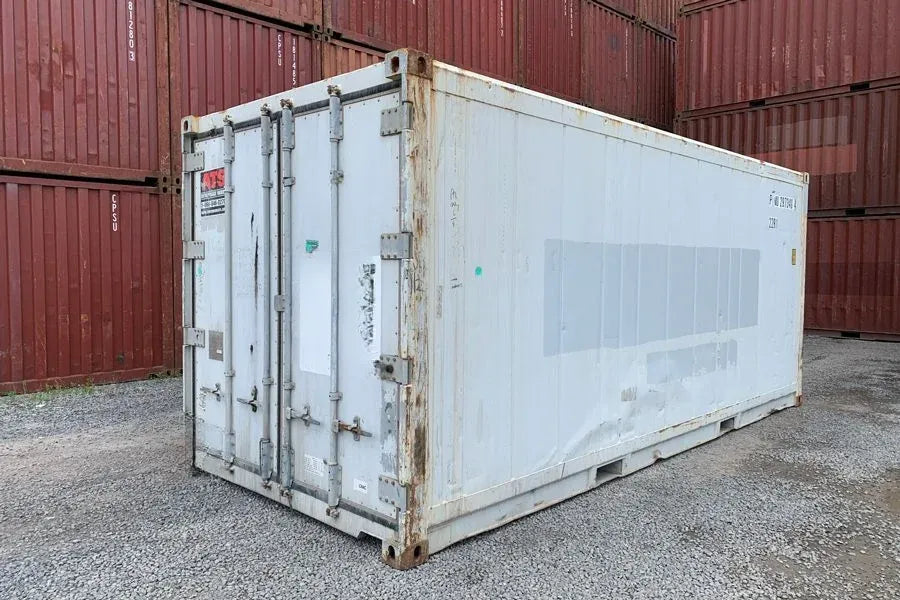
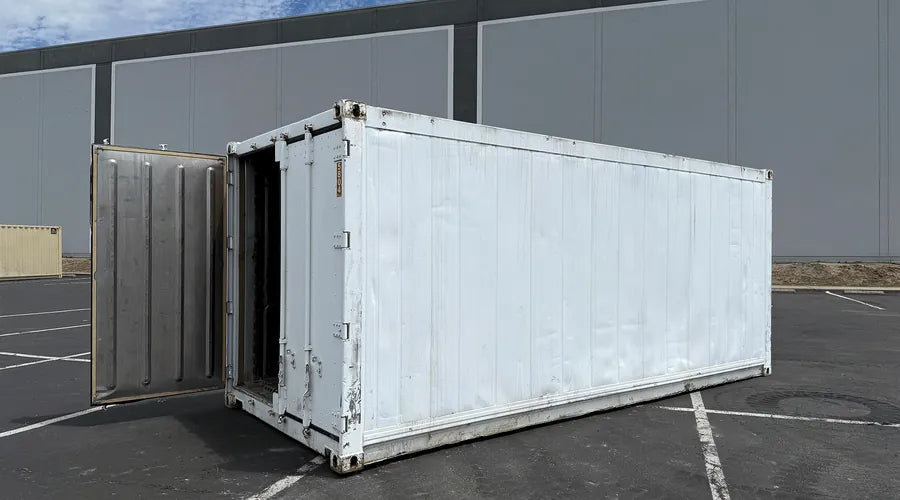
20ft Insulated Shipping Container — First-Trip
Price on request
First-trip version, this 20 ft Insulated container offers 27.30 m3 with reinforced thermal insulation, in pristine, certified new condition. Maximum quality for products requiring long-lasting passive thermal protection.
- Dimensions (LxWxH)
- 6.1 m × 2.4 m × 2.6 m
- Floor area
- 12,5 m²
- Volume
- 27,30 m³
Your price alert has been created. We will contact you by email when new arrivals match the selected products.
What our customers say
Custom-built
Standard and custom-built modules, individually or assembled.
Expertise
Industry experts to support you with your project.
Express delivery
Reliable and secure transport — a logistics team dedicated to your project.
Competitive pricing
Depots across France, close to you.
Compliance
ISO 9001 and CSC standards.
Devis gratuit
Demander un devis pour ce conteneur
Réponse d'un interlocuteur dédié sous 24 h ouvrées, au prix du marché.
Impossible d'envoyer la demande pour le moment. Veuillez reessayer.
Demande envoyée !
Votre demande a bien été reçue et sera traitée sous 24 h ouvrées. Pour une réponse immédiate, appelez-nous au +33 9 78 45 18 90.
A project involving a container?
Answer 5 questions — we'll guide you to the ideal solution.
Similar products

Conteneur Isotherme
10ft Insulated Shipping Container — First-Trip
Price on request
View product →

Conteneur Isotherme
10ft Insulated Shipping Container — Used
From 5 760,00 €
View product →

Conteneur Isotherme
40ft High Cube Insulated Shipping Container — First-Trip
Price on request
View product →

Conteneur Isotherme
40ft High Cube Insulated Shipping Container — Used
From 4 200,00 €
View product →
Technical specifications
| External dimensions | 6,058 m × 2,438 m × 2,591 m |
|---|---|
| Internal dimensions | 5,380 m × 2,280 m × 2,240 m |
| Door clearance | 2,280 m × 2,260 m |
| Tare weight | 2 990 kg |
| Payload | 27 580 kg |
| Volume | 27,30 m³ |
| Floor area | 12,5 m² |
| Materials | Fully welded Corten and stainless steel |
| Floor type | Aluminium rail |
| Door opening | 270° |
| Certifications | CSC |
| Type | Conteneur Isotherme |
| Reference (SKU) | conteneur-20-pieds-isotherme-premier-voyage |
FAQ
What is the lifespan of a container?
With minimal maintenance, a Corten steel container has a lifespan of 20 to 30 years. First-trip units offer the best longevity.
Can a container be customized?
Yes: RAL paint, additional doors, windows, insulation and electrification. Contact us for a custom quote.
Do you offer rental?
Yes, we offer short-term and long-term rental solutions. Contact our team for terms and conditions.
What payment methods do you accept?
Bank transfer, credit card and other payment methods confirmed on the quote. PayPal and interest-free payment in 3 installments are not offered.

20ft Insulated Shipping Container — First-Trip
Price on quote
In detail
What is a 20ft first-trip insulated container?
An insulated container is a fully insulated body: its walls slow heat exchange between the goods and the outside. It does not produce cold; it preserves it. "First-trip" means it is a new unit, out of the factory after a single positioning journey.
The body, made of Corten steel and stainless steel, is fully welded. Corten steel is a self-weathering steel that naturally resists marine corrosion. Insulation is provided by polyurethane foam panels, an insulating foam molded between two walls, 7 cm thick, applied to the sides, ceiling and doors. The aluminum T-bar floor offers a flat, draining surface for rolling loads.
The 20ft format provides 27.30 m³ of usable volume for a 27,580 kg allowable load, at a standard exterior height of 2.591 m compatible with all logistics equipment. This mid-size format fits into short and medium refrigerated flows, where the absence of a power constraint becomes a decisive operational advantage.
In detail
Insulated or Reefer: what is the difference?
The insulated container and the Reefer belong to the same refrigerated family, but rely on two opposite principles. The Reefer, a refrigerated container, carries an active cooling unit: it produces its own cold and maintains a chosen temperature, from −25°C to +25°C. It must stay permanently plugged into a 380V three-phase electrical supply.
The insulated container, on the other hand, produces no cold at all. It simply slows heat exchange through its insulation. It works without electricity and without a cooling unit to maintain. To extend autonomy, eutectic plates are added; cold accumulators frozen in advance in a cold room. On the 20ft format, passive autonomy reaches 24 to 72 hours depending on accumulator density.
This structural difference explains the gap in acquisition cost between the two families, which can reach 60% for equal dimensions. The Reefer incorporates a complete refrigeration mechanism and requires ongoing maintenance; the insulated container is limited to an insulated shell, with near-zero maintenance.
Applications
Uses for a 20ft first-trip insulated container
The new body's thermal inertia is put to use on short cycles, or combined with eutectic plates on trips of one to three days.
The applications below show in which contexts this format is most relevant. Each use links the on-the-ground need to the container's concrete benefit.
Highlights
Why buy a 20ft first-trip insulated container
The new 20ft insulated container is a standard-format passive cold room, delivered ready to use. The strengths below explain what the absence of a cooling unit concretely changes, autonomy, simplicity, cost, and the role of eutectic plates in extending thermal retention.
The strengths below explain what each technical choice brings to the project. They help compare the product with a less specialized alternative or a different condition.
-
No 380V supply required
Immediate deployment on non-electrified sites, with no generator or truck connection in transit.
-
Near-zero maintenance
The absence of a cooling unit removes refrigeration technician visits and refrigerant recharging.
-
Lower acquisition cost
Compared with an equivalent Reefer, for flows where active regulation adds no value.
-
Compatible with eutectic plates
Passive cold autonomy brought to 24-72 hours, recharged in a cold room between trips.
-
Original compliance
ISO 6346 marking and CSC plate for multimodal transport, maritime, rail, road, with no recertification.
-
Optional ATP approval
Configuration in class IN or IR for transporting perishable goods under controlled temperature.
Applications
What is the price of a 20ft first-trip insulated container
The new 20ft insulated container belongs to a specialized shipping segment. The value of the insulated body and the rarity of units converted from a Reefer weigh more heavily here than the price of steel alone.
Four factors influence price variations:
The factors below explain why the price can vary from one quote to another. They help read a quote by distinguishing the price of the product, availability and delivery costs.
Delivery
Delivery & logistics
National Conteneur delivers throughout mainland France and internationally. Lead times and conditions vary by zone and mode of transport.
Next step
Have a project? Request a quote.
Our advisors respond within 24 business hours with a detailed quote based on your volumes, site and timeline.